Yield Management in Performing Arts Venues
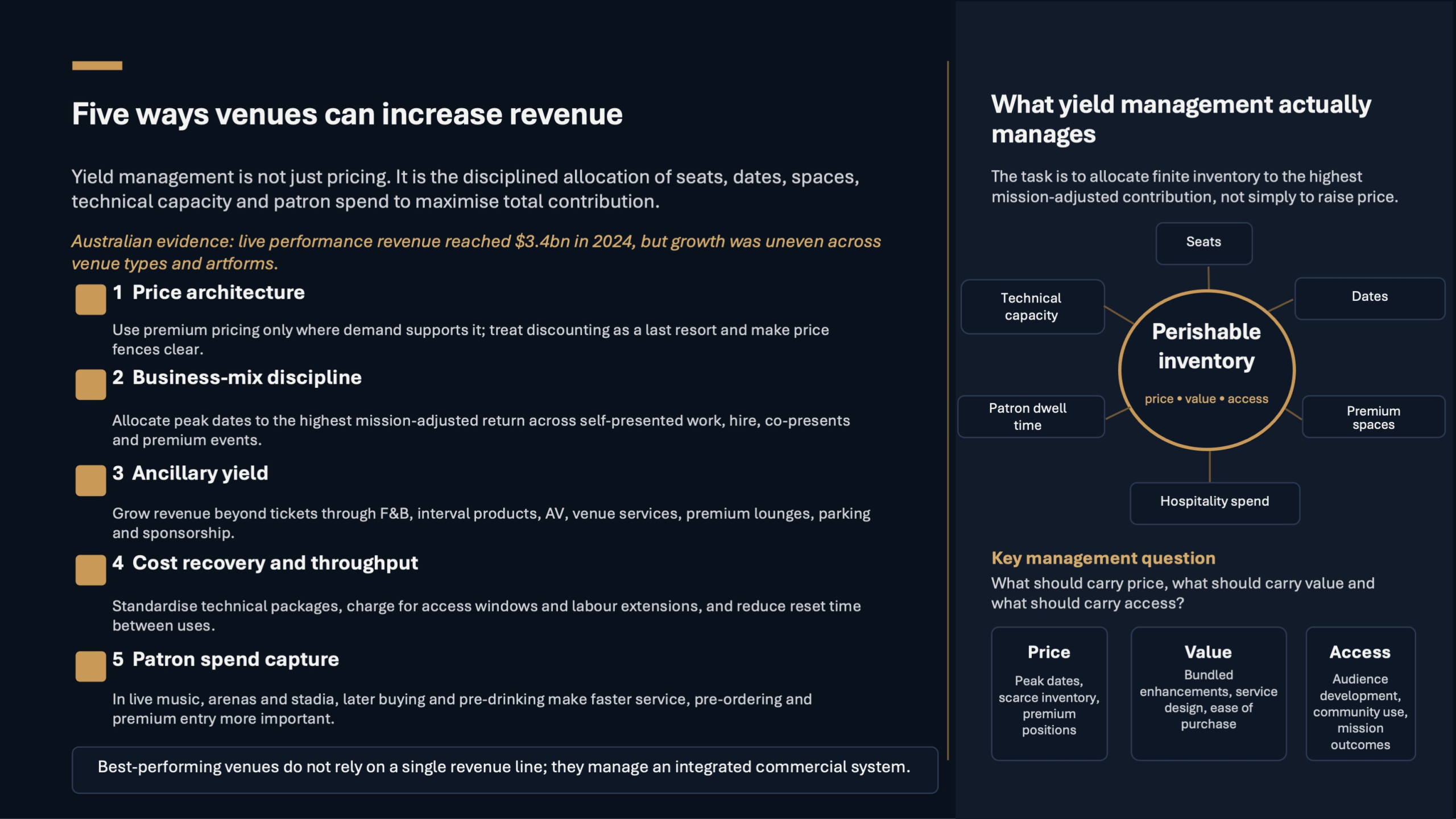
Yield management in Performing Arts venues is often discussed as though it were simply a ticket-pricing tactic. In reality, it is a much broader venue-management discipline. At its core, it is the strategic management of perishable inventory: seats, dates, days, premium spaces, technical capacity, hospitality spend and patron dwell time. That matters now more than ever. Live Performance Australia[1] reported that the sector reached record highs in 2024, with $3.35 billion in ticket revenue and 31.45 million attendances, but that growth was concentrated in a small number of categories. Contemporary music grew strongly, while theatre revenue fell 13.4 per cent, opera fell 22.2 per cent and multi-category festivals fell 9.0 per cent. In other words, overall growth is not evenly distributed across the venue ecosystem.
For venue operators, that distinction is critical. A sold seat, a booked hall or a full building does not automatically mean the venue has yielded well. High utilisation can still produce weak returns if the event is under-priced, if the date displaces a more valuable use, if the technical package is under-recovered or if food, beverage and premium inventory are poorly captured. Yield management, properly understood, is therefore about contribution rather than volume. It asks not only whether the venue sold the inventory, but whether it sold the right inventory, to the right customer, under the right conditions, at the right total return. The live performance sector itself recognises that pricing is influenced by day of week, time of day, seat location and the popularity of the artist or production and that these strategies are typically set in advance by the artist, promoter or producer. At the same time, the recent federal parliamentary inquiry into live music[2] recommended stronger fee transparency and limits on extreme ticket-price variability, which is a reminder that yield without audience trust is self-defeating.
Venue data makes the point clearly: large cultural venue precincts are not dependent on a single revenue line. Figure 1 outlines the revenue mix at major Performing Arts venues across the country.
Figure 1 – Revenue mix at major Performing Arts venues
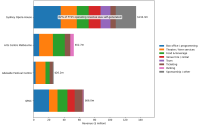
Note: Categories have been harmonised for comparison. Adelaide Festival Centre $ values are derived from its disclosed commercial revenue total ($26.209M) and % mix. QPAC Box Office/Programming uses project income. Sydney Opera House Sponsorship/Other includes other self-generated items.
At the Sydney Opera House, 82 per cent of FY25 operating revenue was self-generated. This included $35.6 million in gross box office, $21.1 million in theatre services, $15.5 million in food and beverage, $15.4 million in venue hire, $13.0 million in tours and $7.1 million in ticketing revenue. Arts Centre Melbourne reported $52.7 million in sales of goods and services in 2023–24, including $18.1 million in theatre services, $15.7 million in food and beverage, $7.1 million in ticketing, $7.3 million in programming revenue and $4.5 million in car park income. Adelaide Festival Centre reported $26.209 million in key commercial revenue in 2024–25, with theatre services contributing 50 per cent, catering 20 per cent, ticketing 16 per cent, box office 10 per cent and sponsorship 4 per cent. QPAC recorded $66.0 million in user charges and fees in 2024–25, including rental income, project income, food and beverage sales, ticketing commissions and services provided to commercial hirers. These organisations are not merely selling tickets; they are managing an integrated commercial system.
That has an important implication for performing arts centres and theatres. The first question should not be, “Can we raise prices?” but rather, “Which inventory should carry price, which should carry value and which should carry access?” In many theatres, the blunt use of discounting has become a substitute for strategy. Yet sector guidance including from peak bodies such as CircuitWest[3] is clear that dynamic or demand pricing only works for events that are genuinely in demand and that discounting should generally be a last resort. The Sydney Theatre Company has used yield management successfully over a number of years. Their 2024 annual report[4] reinforces why this matters operationally: it states that ticket-buying patterns have changed since COVID, while also recording 512,155 paid attendees across Sydney, touring and licensed productions in 2024, plus another 51,476 attendees to work presented by external producers in its venues. The lesson is that pricing architecture must sit alongside programming architecture. Scale design, flexible packaging, release strategy, access offers and booking-curve management all matter more than sporadic discount campaigns.
The next layer is business-mix management. This is where yield management becomes unmistakably a venue-management problem rather than a ticketing problem. A Saturday evening on a premium date should not automatically go to the first enquiry or the loudest stakeholder. It should go to the use that creates the strongest mission-adjusted contribution across the full venue ecosystem. Sydney Opera House’s 2024-25[5] annual report makes explicit that high demand and limited venue availability require careful management of access for internal business units, resident companies and external hirers, supported by formal booking criteria. Sydney Theatre Company’s use of its venues by external producers shows another side of the same equation: the venue can operate as both a producing platform and a hire platform, and the highest-value use may vary across dates, seasons and room types. The most sophisticated venues therefore manage a portfolio: self-presented work, co-presented work, commercial hire, community access, rehearsals, corporate events and premium hospitality are all assessed through the lens of displacement and contribution, not treated as separate silos.
Ancillary yield is where many venues still leave money on the table. In live entertainment buildings, the interval, the foyer, the pre-show window, the rehearsal period, the premium lounge, the backstage service package and the last-mile technical offer are all revenue opportunities. QPAC[6] provides a strong Australian example. Since reopening in October 2024 after a refurbishment, its Storytellers café served more than 70,000 meals and 45,000 coffees. In 2024–25, QPAC reported $12.9 million in food and beverage sales, $10.6 million in ticketing commissions and charges, and $11.2 million in services provided to commercial hirers. It also noted that rising activity increased direct casual employment in production, visitor and hospitality services, with those costs either recovered from hirers, funded through project income or absorbed into food and beverage sales. That is exactly how venue leaders should think about yield: not as isolated ticket revenue, but as a chain of monetisable touchpoints supported by clear cost recovery. The operational response is straightforward: standardise technical packages, charge transparently for access windows and labour extensions, design premium interval and pre-show products and make it easier for patrons and hirers to buy early rather than negotiate late.
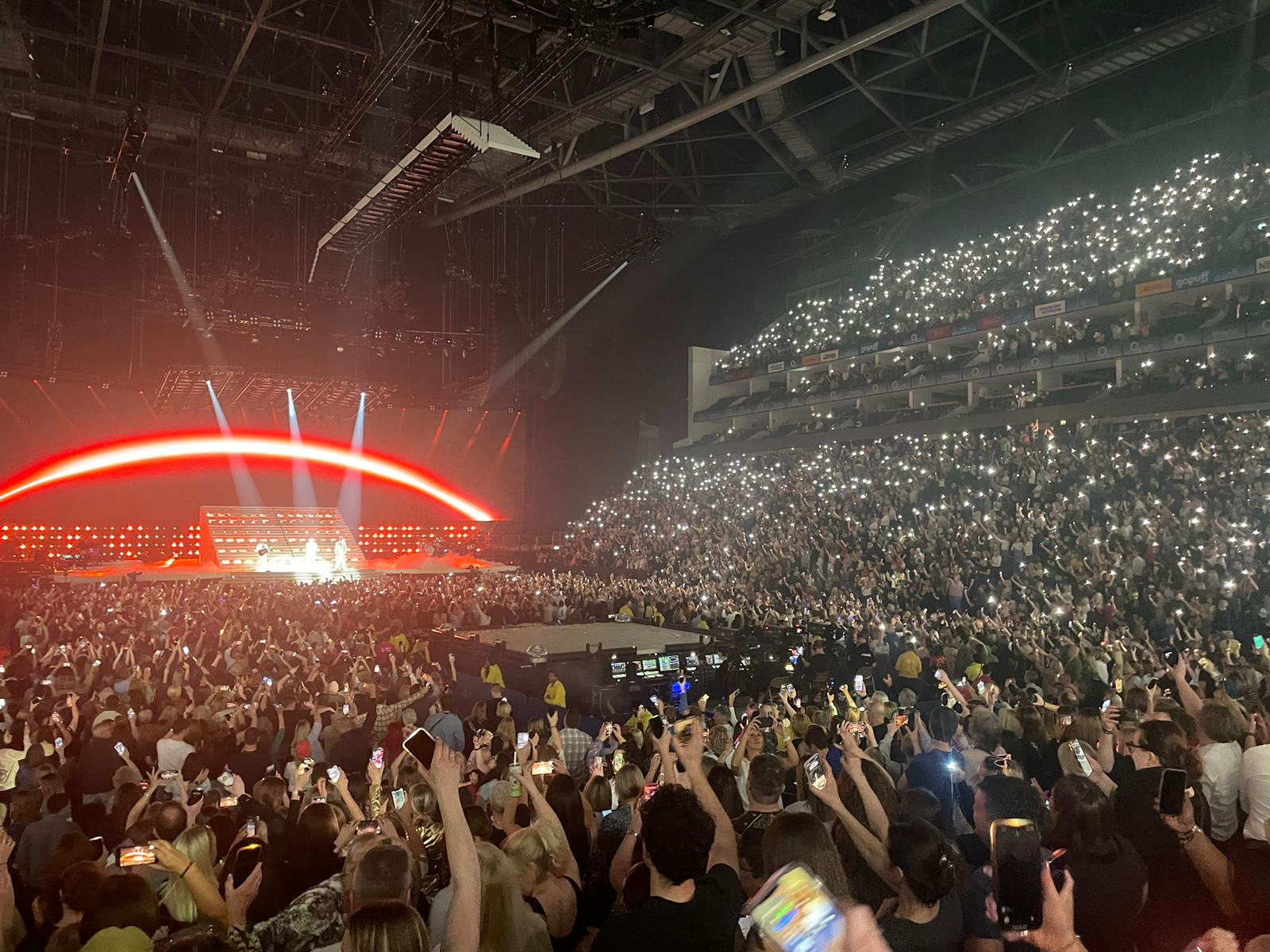
For live music venues, arenas and stadia, the yield equation is slightly different but no less pressing. Music Australia’s 2025 research[7] found that major venues are now the most popular setting for live music, while attendance at pubs and clubs has declined since 2019. It also found that 72 per cent of music-engaged respondents had saved up money to attend one or more major live music events in the previous 12 months, that audiences are buying later, and that more than half drink before arriving because of high alcohol prices inside venues. For operators, this is a crucial signal. A venue cannot assume that strong ticket demand will automatically convert into strong per-capita bar spend. Nor can it assume that late-purchasing audiences will tolerate opaque pricing or cumbersome purchasing journeys. In this environment, better yield is likely to come from clearly tiered premium products, faster service design, pre-ordered food and beverage, integrated transport and parking offers, premium entry experiences, and sponsorship or hospitality products that feel additive rather than extractive.
The broader strategic point is that yield management in cultural and live entertainment venues should not be understood as a race to charge the highest possible price. In publicly supported performing arts centres especially, that would be too narrow and, in some cases, inconsistent with public purpose. The better framing is disciplined value allocation. Some inventory should maximise revenue. Some should build audience depth. Some should protect access, participation or sector development. The leadership task is to decide consciously which is which, and then align pricing, programming, operations and customer experience around that decision. That is why the strongest venues are increasingly those that combine commercial intelligence with curatorial discipline and operational clarity. They do not merely fill the building. They understand the value of each seat, each space, each hour and each customer interaction and they manage all of them together.
[1] https://liveperformance.com.au/contemporary-music-drives-live-performance-growth-in-2024/
[2] https://www.aph.gov.au/Parliamentary_Business/Committees/House/Former_Committees/Communications/Livemusicindustry/Report/List_of_recommendations
[3] https://circuitwest.com.au/resource/ticketing-strategies-pricing-and-packaging/
[4]https://www.sydneytheatre.com.au/-/media/project/sydney-theatre-company/sydney-theatre-company/about/annual-reports/stc_annualreport_2024_final_spreads.pdf?rev=9cf92a14530c41aca94ef58e7cf4b03c&hash=0BDA6A3314BA9DBE80B8B6D11115CC1C
[5]https://www.parliament.nsw.gov.au/tp/files/192295/2024-25%20Annual%20Report%20Sydney%20Opera%20House.pdf
[6] https://www.parliament.qld.gov.au/Work-of-the-Assembly/Tabled-Papers/docs/5825T1469/5825t1469.pdf
[7] https://creative.gov.au/news-events/news/strong-audience-demand-live-music-lives-despite-cost-living-pressures
Related Posts





Recent Projects


